
Green Spaces and Mental Health: Small Doses of Nature for Everyday Resilience
Discover how green spaces can support mental health, wellbeing and resilience — and why even a view of trees or a few minutes in nature may matter.
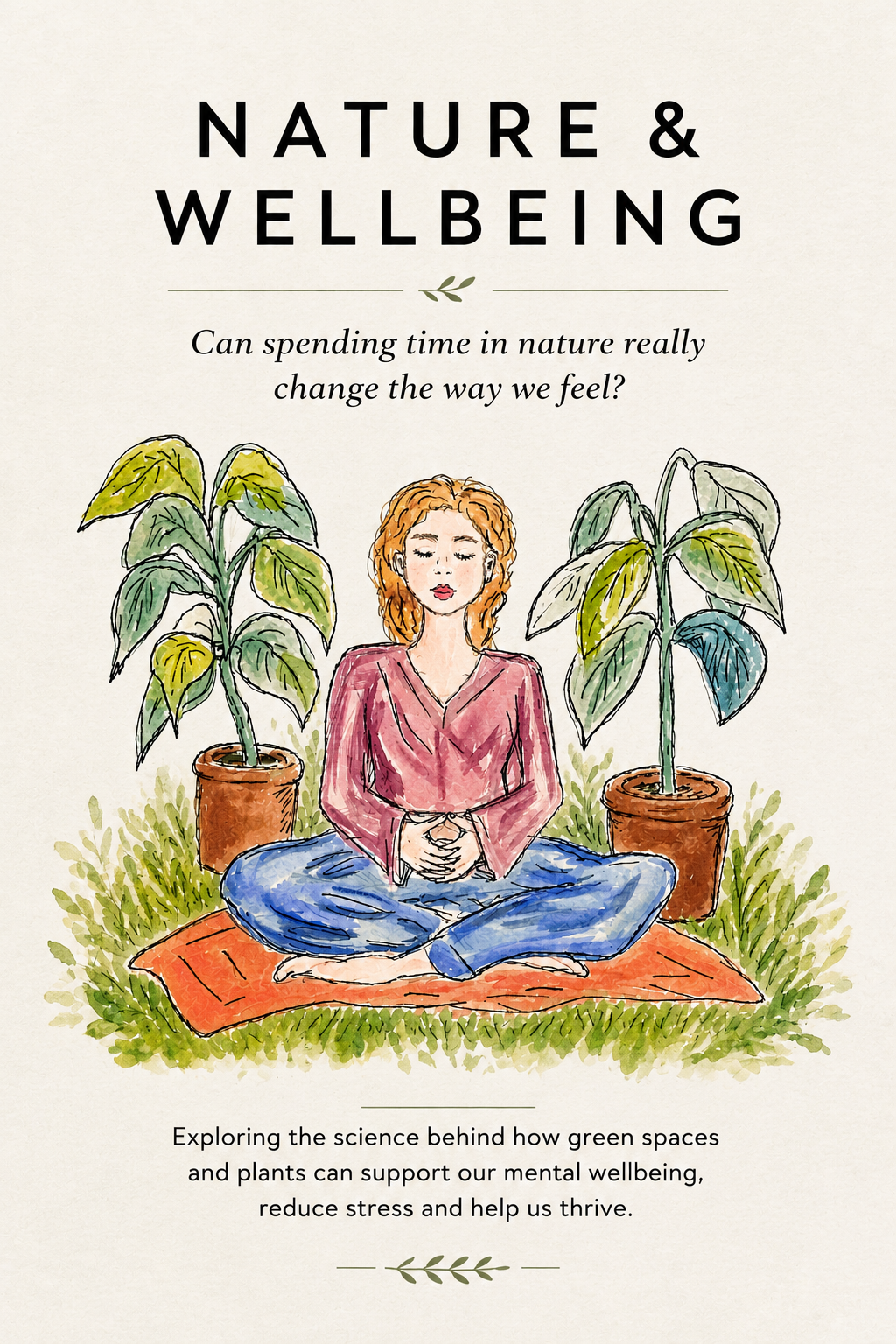
You don’t need to escape to a rain forest in the middle of nowhere to experience the benefits of nature. Even small encounters with greenery may help support our wellbeing and resilience.
For many of us, modern life can make the divide between everyday life and connecting to nature feel increasingly distant.
A large portion of the world lives a "desk to couch lifestyle", spending much of our time indoors, looking at screens and moving between homes, workplaces, cars and shops. Often not by choice, rather it is the design of this current modern world. So, when we think about the concept of “connecting with nature” it may seem like another unattainable goal suggested by health gurus designed to make us feel like we are missing out yet again.
But what if it was easier to get in touch with nature than you first thought?
What about the tree outside your window, the plants on your balcony or the small park at the end of your street?
Research suggests these everyday encounters with greenery may be more valuable than we realise.
You Don’t Need to be surrounded by a rainforest
Research into green spaces and mental health has found associations between exposure to greenery and enhanced measures of wellbeing. The important takeaway factor being that the nature around us doesn’t necessarily have to be expansive.
A study of 3,000 adults in Tokyo examined different forms of nature exposure alongside measures including happiness, life satisfaction, self-esteem, loneliness, anxiety and depression.
A key highlight of this study showed that nearby views of nature — including seeing trees through a window — were associated with improved markers of mental health.
While this study cannot prove that seeing greenery directly caused increased mental wellbeing, it raises an interesting and encouraging possibility: supporting our wellbeing through nature may be more accessible than we think.
So don’t dismiss that short break in the work courtyard, that quick 10-minute walk at work to the inner-city park or even a window break to gaze at nearby trees and nature. These small movements towards nature might help improve your mental health more than first considered.
The Best Green Space Might Be the One Nearby
Another study involving more than 1,000 adults in Brisbane examined urban green-space use during a period of unusually high stress.
One important finding was the role of accessibility.
Green spaces within walking distance were particularly important, suggesting that the everyday park we can easily reach may sometimes be more useful for our wellbeing than spectacular natural environments we rarely visit.
This reiterates an important concept: We don’t necessarily need more time for nature. We may need to notice and use the nature already around us.
Nature and Everyday Resilience
Although some of this research was conducted during the COVID-19 period, its findings raise a broader question for life today:
Could small amounts of nature help us become more resilient to everyday stress?
Due to the nature of modern stress, involving constant notifications, long periods indoors stuck under artificial lighting and the work pressure demands many of us face, there appears little room for incorporating actual nature into mental recovery.
Nature doesn’t need to become another short-lived wellbeing task we have to perform perfectly.
Instead, we can think of greenery as part of an environment that supports us.
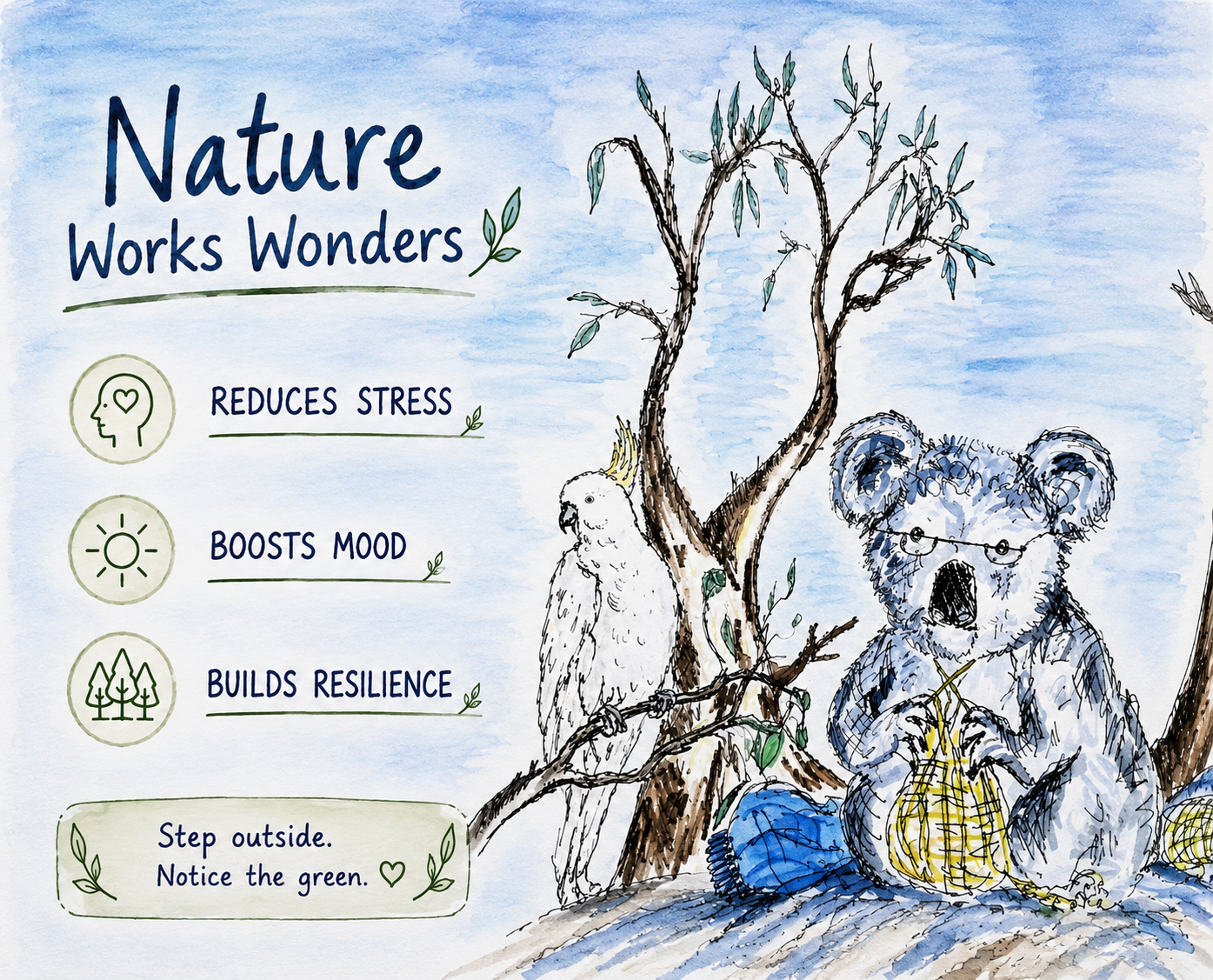
Try a “Micro-Dose” of Nature
The easiest and usually most realistic way to test a wellbeing intervention (in an already hectic life!) is by integrating mini, bite-sized encounters with nature into activities you’re currently actively doing.
Try drinking your morning coffee in a sunny patch of grass, take the slightly longer greener route home, take your lunch outside and find a tree to hang out with, move your desk towards a leafy view or get a pot plant for your desk, or simply sit in a nearby park without feeling that you need to turn the experience into exercise.
None of these actions are time eaters and can easily be integrated into everyday life.
That’s precisely the point.
Sustainable wellbeing practices may be the ones that fit naturally into our lives rather than requiring us to find an excuse to get out of them.
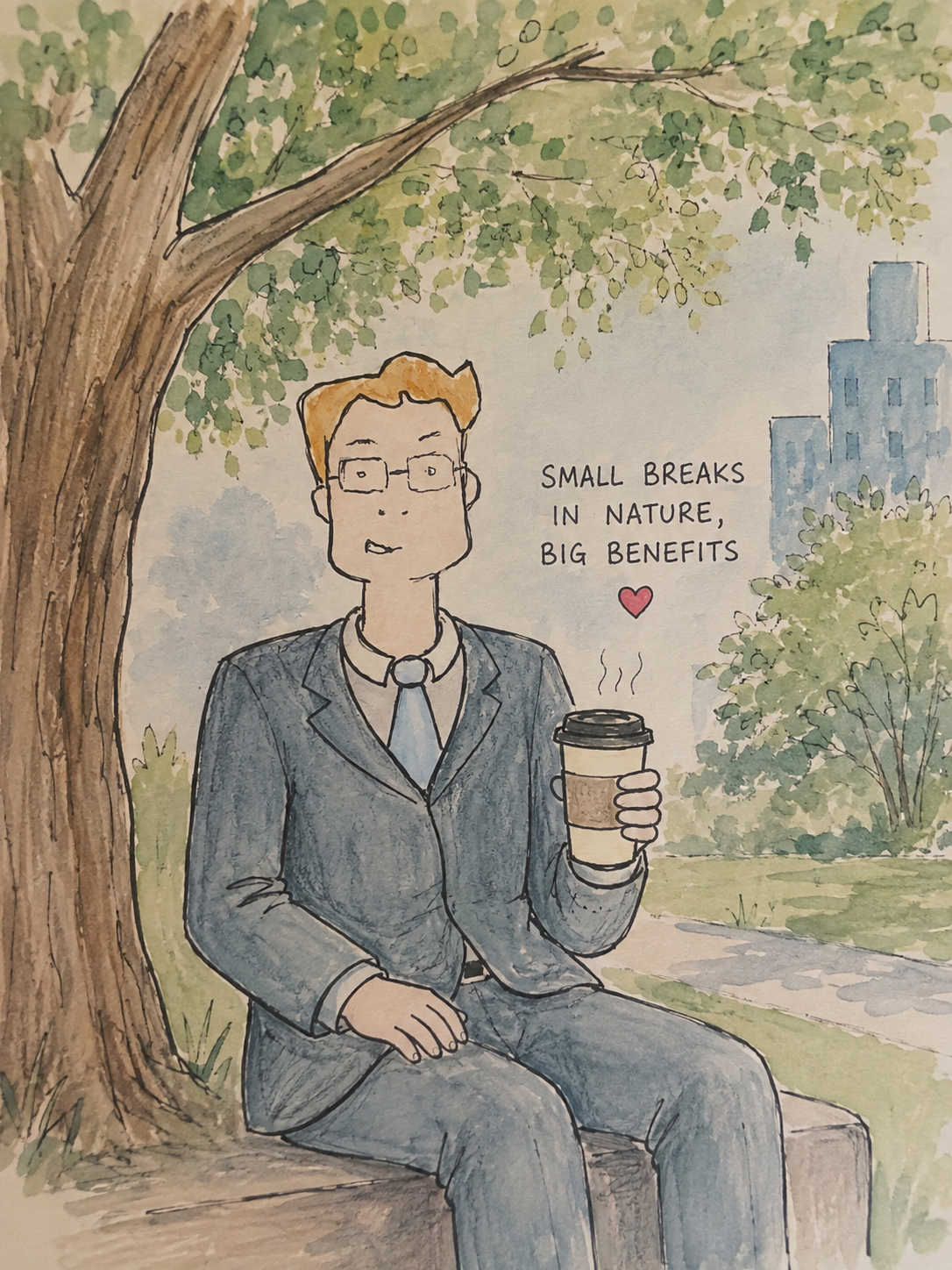
Research cannot tell us that every small encounter with greenery will make us happier or more resilient. But the relationship between nearby nature and measures of wellbeing gives us a good reason to pay more attention to our everyday environments.
Research Behind This Article
Berdejo-Espinola, V., Suárez-Castro, A., Amano, T., Fielding, K., Oh, R., & Fuller, R. (2021). Urban green space use during a time of stress: A case study during the COVID-19 pandemic in Brisbane, Australia. People and Nature, 3(3), 597–609.
Dadvand, P., Bartoll, X., Basagaña, X., et al. (2016). Green spaces and general health: Roles of mental health status, social support, and physical activity. Environment International, 91, 161–167.
Korn, A., Bolton, S., Spencer, B., et al. (2018). Physical and mental health impacts of household gardens in an urban slum in Lima, Peru. International Journal of Environmental Research and Public Health, 15(8), 1751.
Soga, M., Evans, M., Tsuchiya, K., & Fukano, Y. (2021). A room with a green view: The importance of nearby nature for mental health during the COVID-19 pandemic. Ecological Applications, 31(2).


