
Can a regular Yoga Practice Help Us in Our Professional Lives?
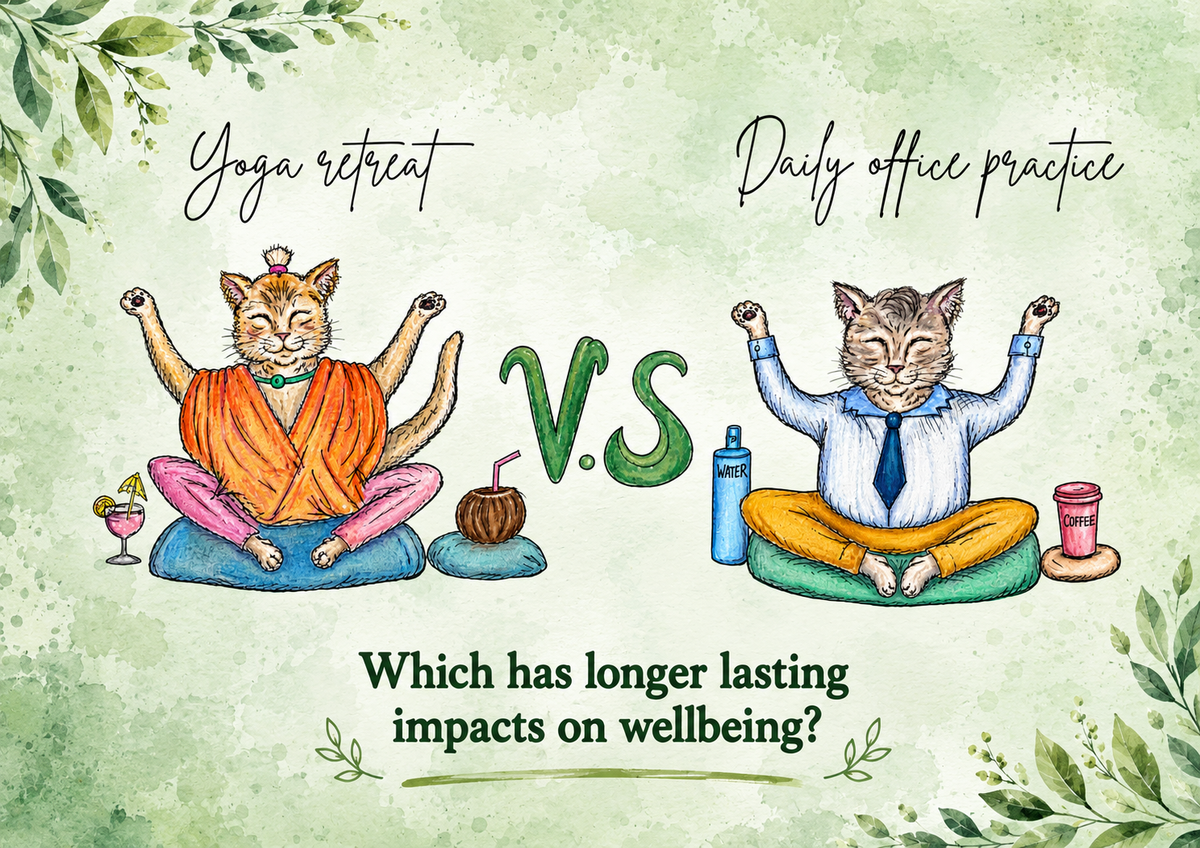
Stuck in the nine to five grind and over it?
You get home and think “yes, it’s finally over, now it’s time for me.” Alas, then some other real-life thing comes along to spoil it all. The cat vomits on the carpet, you open the mailbox to find a hideous bill, the bins need taking out…. You also can’t get that latest drama from work out of your head and can’t stop replaying that annoying conversation with your boss.
Your shoulders are tight, your jaw is clenched and you know you should probably do something to prevent all this stress.
Yes, okay, like what?
We’ve all heard the usual suggestions: exercise more, take breaks, practise mindfulness, get enough sleep…
But what about yoga?
Yoga is generally associated with flexibility, physical health and relaxation, but research suggests its benefits might also extend into our professional wellbeing.
So, could spending some regular time on the yoga mat make our working lives a little easier? A little more palatable?
Work stressing you out? You’re not alone.
Workplace stress is a particular concern in many high-stakes professions such as teaching and education, as well as those working in toxic workplace environments.
Stress-related problems can contribute to burnout, absenteeism and presenteeism and may even play a role in people leaving the profession altogether.
Teaching and education are areas where burn out is highly prevalent, and an area where there have been many studies collected around the benefits of mindfulness. Despite this, very few studies have investigated the real-life impact yoga may have to support teachers and other education professionals
Yoga has already been studied for its potential physical and psychological wellbeing benefits in other populations.
So, what happens when researchers actually give stressed teachers some yoga?
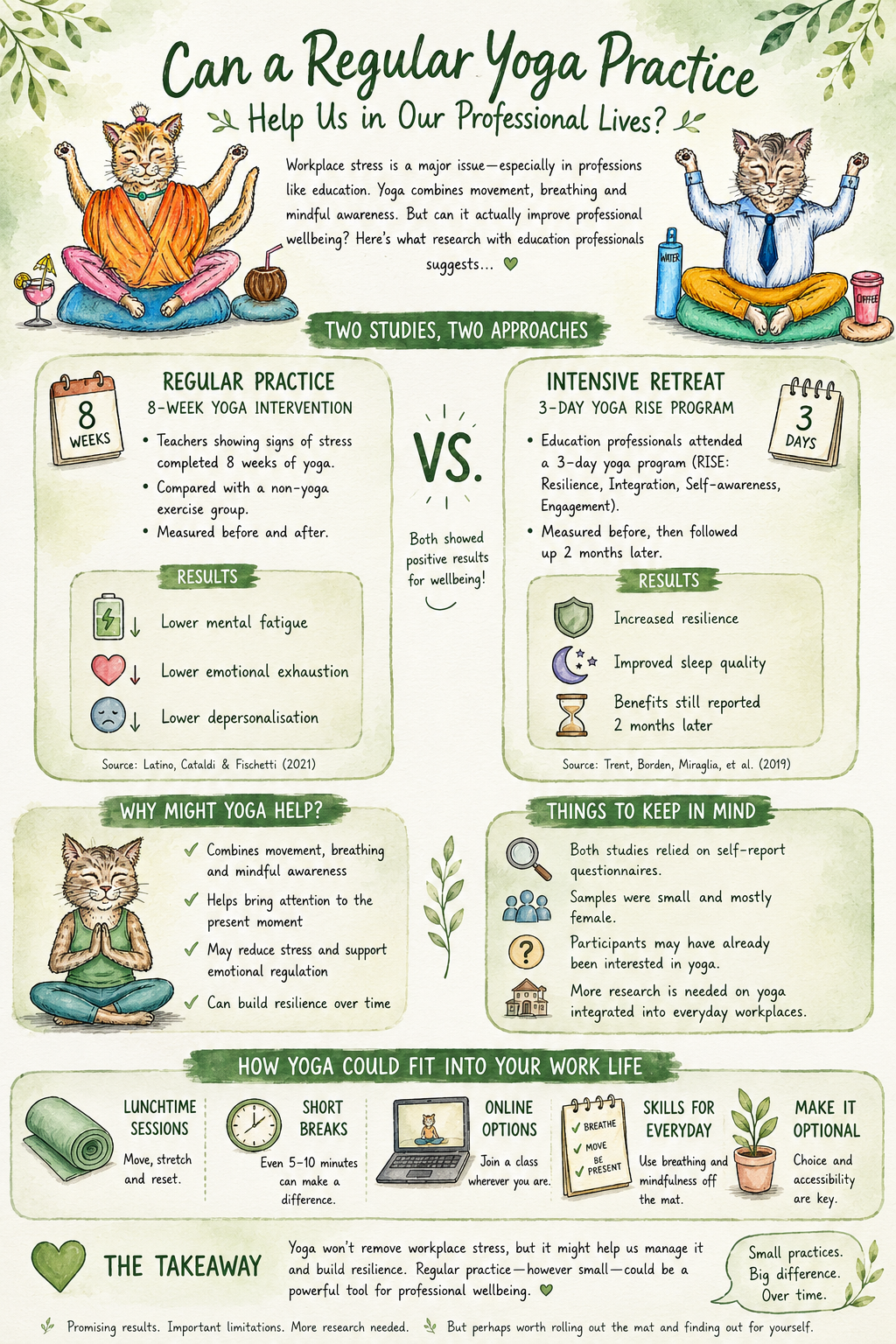
Eight weeks of yoga vs regular exercise
One study put a group of Italian high-school teachers through an eight-week yoga program.
Another group completed an eight-week non-yoga exercise program, giving the researchers an opportunity to compare ordinary physical exercise with yoga. Participants’ wellbeing and burnout were measured before and after the intervention.
And yoga came away with some interesting results.
After eight weeks, the yoga group reported lower mental fatigue, emotional exhaustion and depersonalisation than the exercise comparison group.
So perhaps it isn’t just the physical exercise that matters.
Yoga combines movement with breathing, concentration and mindful awareness. Rather than simply getting our bodies moving, we’re also practising bringing our attention back to what we’re doing right now.
And when your brain has spent eight hours jumping between emails, deadlines, meetings and other people’s problems, that might be quite a welcome change.
But I don’t have eight weeks!
Fair enough.
Another study looked at what happened when education professionals participated in a much shorter three-day yoga-based program called RISE — Resilience, Integration, Self-awareness and Engagement.
Rather than waiting eight weeks, participants experienced an intensive three-day program and were then followed up two months later.
Participants reported increased resilience, and some positive changes — including improvements in sleep quality and resilience — were still being reported two months later.
Not bad for three days on the yoga mat!
So…should we all book a yoga retreat?
Not necessarily.
The three-day study didn’t have a control group, whereas the eight-week study compared yoga with another form of exercise. Both studies also relied heavily on people reporting their own wellbeing through questionnaires.
There were other limitations too.
Most participants were women, the samples weren’t particularly large, and some participants may already have had an interest in yoga. That could mean we’re looking at people who were more enthusiastic about taking part in a yoga program in the first place.
So, while the findings are promising, these studies can’t conclude that yoga is going to transform everyone’s working life.
Retreat or routine?
To retreat or not to retreat, that is the question.
Both interventions took place away from participants’ normal day-to-day working routines. Meaning that there is a large gap in this research that could be explored by asking the question: What would happen if yoga simply became a small, regular part of the working week?
Imagine optional lunchtime yoga at work.
Or a short session before heading home.
Perhaps even ten minutes of movement and breathing between finishing work and switching into the rest of your life.
By finding ways yoga could be integrated easily into the working week, sustainable change could occur, leading to positive mental and physical health outcomes and fewer incidents of burnout.
Could yoga make us better at our jobs?
Probably not.
It won’t cancel tomorrow’s meeting or magically turn a toxic workplace into a healthy one.
But these studies suggest that yoga deserves further investigation as a way of supporting the person doing the job.
An eight-week intervention was associated with reductions in mental fatigue, emotional exhaustion and depersonalisation, while participants in a brief yoga-based program reported improvements in resilience that remained evident at a two-month follow-up.
There are still gaps in the research and larger, longer-term studies are required. particularly research examining yoga when it is actually incorporated into everyday working life.
The exciting part of all these findings is yoga is an intervention that can easily be experimented with in our own lives.
Chuck on a yoga YouTube video for 15 mins before work or when you get home.
Get out of work on time and head to that bougie yoga studio you’ve been hearing about.
Or even be bold and bring up implementing yoga sessions at work in your next team meeting.
Any little bit counts and you may just find yourself just that little bit more refreshed and ready to tackle another day, work drama or not!
Research used for this blog:
Alexander, G., Innes, K., Selfe, T., & Brown, C. (2012). “More than I expected”: Perceived benefits of yoga practice among older adults at risk for cardiovascular disease. Complementary Therapies in Medicine, 21(1), 14-28.
Latino, F., Cataldi, S., & Fischetti, F. (2021). Effects of an 8-Week Yoga-Based Physical Exercise Intervention on Teachers’ Burnout. Sustainability (Basel, Switzerland), 13(4), 2104.
Trent, N., Borden, S., Miraglia, M., Pasalis, E., Dusek, J., & Khalsa, S. (2019). Improvements in Psychological and Occupational Well-being Following a Brief Yoga-Based Program for Education Professionals. Global Advances in Health and Medicine, 8, 2164956119856856.


